

Kimomanzi Quality Management Implementation Program
To implement a Quality Management System is no easy task,
However, we have done ALL the hard work for you.
All you have to do is to adjust our work to suit your needs
with our automated, structured and easy to follow
roadmap from start to finish.
IN 6 EASY STEPS!
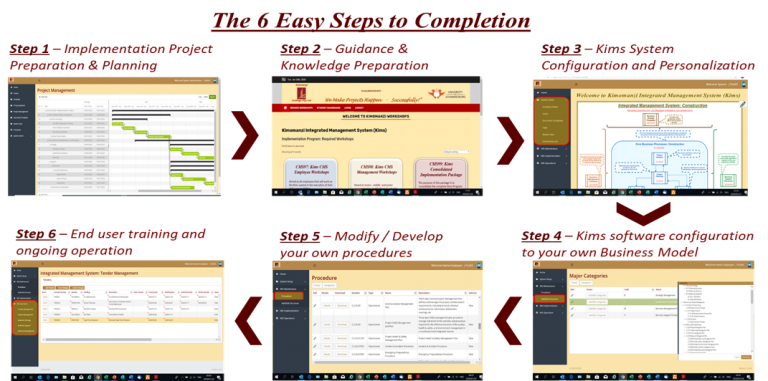
The Program Components
Kims Introduction Workshop
The Kims Introduction Workshop provides you with an overall “birds eye” view of what the Kims Implementation program includes, what it is all about and discuss who the required participants are, what their responsibilities are and the base objectives of the program.
Kims Project Management Plan
The saying “Plans are Nothing – Planning is Everything” is VERY true when implementing a Quality Management System.
No project can be successful if you dive “head-first” into it without any proper planning.
In order to assist you to manage your project, we developed a template to use that includes:
– All required activities
– Suggested procedure summary
– Suggested operational document summary
– Allocation of responsibilities
– Time management
– Measurement of actual progress
Kims Knowledge Workshops
The Knowledge Workshops are divided into “bite-size” modules (+- 90 minutes each) to make it easy to digest.
It can be delivered via:
– e-Learning: online in your own time
– Zoom workshops: 3 day online webinar
– In-Contact workshops: 3 day in person workshops (on-site or public)
The discussion workshops consist of:
KIP101 – ISO 9001 Introduction and Overview
KIP102 – Kims Quality Management Structure
KIP103 – Kims Software Introduction
KIP104 – Generic Procedure Development Process
KIP105 – Kims Software: Procedure Development
KIP106 – Kims Software: Operational Execution
KIP107 – Kims System Administration
Kims IMS Software
The Kimomanzi software is at the heart of our implementation program and sets us apart from all other quality management implementation projects.
The online cloud software enables you to know what is happening in your company when it happens.
The software consist of:
System Management:
Under the system management facility you can record your company’s basic information, manage users and their access, and personalize your system.
Maintenance:
This is where you can develop, maintain and control the procedures that you require. The system comes with 46 complete, ready to use procedures and 100+ operational document templates that you can select from and/or change to suit your company within a structured, controlled environment.
Operational Execution:
Arguable the biggest reason why companies do not reap the benefits from a quality management system is as a result of the disconnect between the procedures / documents and the practical operation of the company. This component of the system addresses this in an easy to follow manner.
The procedures and operational documents that you selected/modified under Maintenance is auto-converted to actionable, operational activities to guide and manage the daily operation of your company, making it easy for operational staff to execute correctly AND use the correct documents to do it.
The execution documents are recorded and saved online, and is immediately available to authorized users from anywhere.
46 Different Procedure Templates and 100+ Operational Documents
There are 46 ready to use procedure templates included with the Kimomanzi Software. All you need to do is look through them, decide which is applicable to your company and adjust them to your operational requirements.
In addition to the 46 procedure templates, there are also 100+ documents linked to these procedures making it very easy to execute the daily operations of the company.
These procedures covers the whole spectrum of the business, from strategic planning down to the last operational activity, including:
Strategic Management
Procedures to assist you in the overall, high level management of your company.
Core Business Management
These procedures assists you in managing the daily operations of the company, including Health & Safety.
Support Functions
This includes those activities in support of the Core Business of the company, such as human resources.
Monitor & Measurement Functions
Procedures that enable you to ensure that your Quality Management System, and therefore your company, is on the right track.
10 Procedure Development Workshops
In our experience it does not help to merely provide the procedure and document templates, we have therefore developed 10 workshops (online, Zoom, or in-contact) in order to help you get the most benefit, where we discuss:
– The purpose of each procedure
– The benefit of each procedure
– The relationship of the procedure with the ISO 9001 requirements
These discussions are conducted every Friday morning (09h00 to 12h00) via Zoom, or you can work through them in your own time on e-Learning.
Ongoing Online Support
We provide ongoing online support to all our customers to ensure the smooth implementation and operation of the Kimomanzi Quality Management System.
The Implementation Roadmap
Project Preparation
During the first phase of the implementation program, the basic objectives are:
– To make all staff aware of the project and its requirements
– To conduct the Introduction & Awareness workshops
– To identify active participants in the implementation project
– Formally appoint the project manager and administrator
– To provide participants with a “birds eye” view of the program
– To allocate high level individual responsibilities
– To set the time frame for the completion of the project planning
Project Management Plan
This may be THE SINGLE MOST important phase of the implementation project “PLANS ARE NOTHING – PLANNING IS EVERYTHING“
The basic objectives for this phase is:
– Familiarize the participants with the list of suggested procedures
– Compile a list of internal procedures currently in place
– Compare the two lists (Gap Analysis)
– Compile a provisional requirement list
– Determine the time availability of participants
– Develop the project plan and schedule
Project Training Workshops
During this phase the participants must successfully complete the modules that they are selected to do.
Develop and Test Procedures
By far the most time consuming phase of the project, where the project manager/administrator must discuss each procedure (including related documents) with the responsible people for the functional areas that the procedure falls within, test the execution of the procedure, change and approve the resulting procedure and record the changes on the Kimomanzi software.
During this phase the project manager/administrator and the responsible person for the individual procedure will complete the applicable e-Learning guidance session or attend the weekly 3 hour discussion sessions (via Zoom or in contact) where the purpose, benefit and relation to the ISO 9001 requirements of the procedure are discussed, of which there are 10 sessions in total.
End User Training
Remember that the Kimomanzi System is all about executing the procedure in the daily operation of the company and is therefore critically important that the relevant operational staff understand how to record the daily operations.
All operational and administrative personnel must complete the Kimomanzi End User training.
Implementation
This is the “day of reckoning”, however the guidance provided through all the phases of the implementation project will ensure that everything goes well!
This is the “peg in the ground”, set in the planning phase when the company actually starts working “live” on the system.
The most important part of this phase is to monitor the effectiveness of the system and to proactively resolve any minor issues that may arise.
External Certification Audit
After the system has been running smoothly for a while and all the “teething problems” have been adjusted, external auditors can be invited to do the Certification Audit.